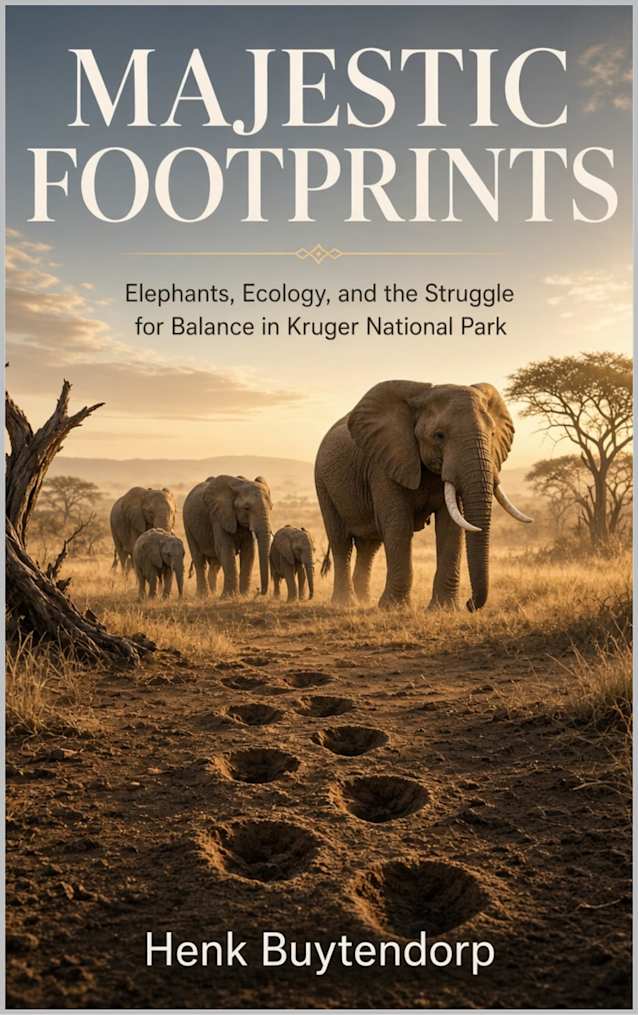
Majestic Footprints: Elephants, Ecology, and the Struggle for Balance in Kruger National Park
About
Majestic Footprints explores the complex reality of elephant conservation in South Africa’s Kruger National Park, where a remarkable recovery in elephant populations has created a new and challenging paradox. Once driven to near extinction in the early twentieth century, elephants in Kruger have rebounded to tens of thousands, representing one of conservation’s greatest successes. Yet this very success has produced unintended ecological and social consequences.
The book examines how high elephant densities affect vegetation, particularly large trees and woodland structure, and how these changes ripple through entire ecosystems. It highlights the role of elephants as keystone species and ecosystem engineers, capable of reshaping landscapes through feeding, movement, and resource use. At the same time, it addresses the human dimension, including conflict with neighboring communities, ethical debates over management practices, and the pressures of tourism and public opinion.
Drawing on scientific research, field observations, and management history, the narrative traces the evolution from earlier interventionist strategies—such as culling and artificial water provision—to modern adaptive approaches focused on maintaining ecological balance and spatial diversity. It emphasizes that there is no simple solution: the challenge lies not in reducing elephant numbers alone, but in managing their distribution and impact within a constrained, human-influenced environment.
Ultimately, Majestic Footprints presents conservation as an ongoing negotiation between science, ethics, and human values, arguing that living with abundance requires careful, adaptive stewardship rather than definitive answers.